Tumor evolution intelligence
GENESIS Oncology
Engineer tumor evolution before resistance wins.
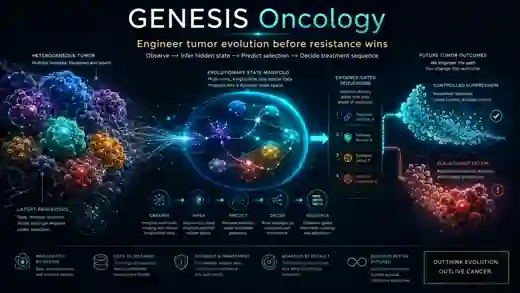
Cancer therapy changes the tumor it is trying to destroy. GENESIS Oncology is built around that fact. Instead of asking only “Which drug attacks the tumor now?”, the platform asks the harder question: “What future tumor does this intervention select for next?”
What the project does
See the tumor you have. Infer the tumor you cannot yet see. Predict the tumor treatment may create.
GENESIS Oncology links measured tumor state, latent reservoirs, intervention pressure, lineage response and replacement escape inside one reasoning architecture. The aim is not merely to predict resistance after it appears, but to identify the evolutionary pathways by which therapy can make a resistant successor more likely — and to compare treatment sequences before committing to them.
Integrate longitudinal, multi-omic, imaging and clinical evidence describing the current tumor.
Reconstruct hidden state, clonal structure and small therapy-tolerant reservoirs that may not dominate current measurements.
Model how candidate interventions change selection pressure and alter the probability of future successor states.
Compare strategies by expected control, escape risk, uncertainty and evidentiary support.
Reason about ordering and adaptation because the state after treatment A is the starting state for treatment B.
Why this is different
The target is not only the tumor. The target is its reachable future.
Conventional snapshot thinking
- Characterizes what is dominant now.
- Often evaluates treatments one at a time.
- Resistance is frequently recognized after selection has already reshaped the population.
- Rare reservoirs can be clinically important even when they contribute little to the current bulk signal.
GENESIS Oncology thinking
- Treats therapy as an evolutionary intervention.
- Represents measured and latent states separately.
- Asks how one intervention changes the state on which the next intervention acts.
- Explicitly reasons about replacement escape: suppressing one population may open ecological space for another.
- Withholds unsupported rankings rather than converting uncertainty into false precision.
Multiple lineages, not one average tumor.
Small populations may become the next dominant state.
Order matters because treatment changes the future state.
Unsupported conclusions are abstained from, not invented.
GENESIS Oncology
Outthink evolution. Change the reachable future.
The platform is designed to make a hidden question visible: not only whether a therapy can suppress cancer today, but what evolutionary successor it may select for tomorrow.